



The son of a pharmaceutical scientist and a regulatory scientist, Rahul Mudumba headed to Indiana University to study a different area: economics. But he wasn’t sure if this was the field he wanted to pursue after earning his bachelor’s.
“I was so fascinated by health sciences, nutrition,” the San Francisco Bay Area native says. He considered a hard pivot toward exercise physiology or public health, fields for which he had taken no coursework. To compensate, he completed an internship at Pharmacyclics, a Bay Area biotech company, and also a public health research stint in Pune, India, where he spent a semester studying food security in rural communities.
His father and a close friend helped Mudumba connect the dots. They pointed out that health economics sat right at the intersection of his quantitative training and healthcare interests.
“I had no clue what it was at the time,” Mudumba says. He grew more interested after a few online classes and decided to learn more about what this field had to offer.
The curiosity carried him to Johns Hopkins University, where he earned a master’s degree in health economics and outcomes research. The deeper he went, the more he wanted to keep going. “I want to be an expert in methodology,” he notes. “I want to get the training to pursue these things deeper, and I’m not capable of doing that with just a master’s.”
He applied to PhD programs, with USC at the top of his list. The reason was clear: USC’s health economics program is the only one in the country that lets students move freely between economics and decision science. “Other programs at top universities make you decide between the two,” he explains. “Here, you take courses spanning both. So I knew if I wanted to get better at the methodology, this was the place to be.”
Mudumba is graduating with a PhD in health economics.

His research at USC focuses on a key question: How do we accurately measure the value of a medical treatment? “The most understudied area for accurately measuring this is called risk preferences,” he explains. “Without conclusive data here, it’s hard to relax the restrictive assumptions underpinning traditional methods for assessing value.”
His dissertation focuses on collecting risk preferences from non-small cell lung cancer patients through a discrete choice experiment, and the findings challenged his own hypothesis. Mudumba expected cancer patients to be far more risk-seeking than the general population. But he found that their preferences between risk and certainty were nearly identical.
What differed was patients’ perception of their own health: They rated their quality of life much higher than outside observers would have predicted, having adapted to their symptoms over time.
Current models, Mudumba explains, undervalue treatments for the sickest patients, effectively pulling resources away from those who need them most. His work builds on the generalized risk-adjusted cost-effectiveness (GRACE) framework pioneered by his advisor, Darius Lakdawalla, University Professor of Pharmaceutical Economics and Public Policy and the Quintiles Chair in Pharmaceutical Development and Regulatory Innovation at the Mann School.
Through GRACE, Mudumba aims to correct that bias and produce models that align with how people actually value health by relaxing restrictive assumptions about risk preferences.
Mudumba also served as president of the USC student chapter of the International Society for Pharmacoeconomics and Outcomes Research (ISPOR), connecting students with alumni across government, industry, academia and consulting. He also completed a doctoral fellowship at AbbVie, where he built cost-effectiveness models in oncology and led real-world evidence studies.
The industry experience, he says, gave new meaning to the academic methods. “By seeing firsthand the application in industry, it shows me how I can design my work in such a way that it matters downstream.”
Mudumba credits Lakdawalla with shaping not just his scholarship but also his outlook on life. “The things I’ve learned just from observing him supersede what you would learn or ask from a mentor,” he notes.
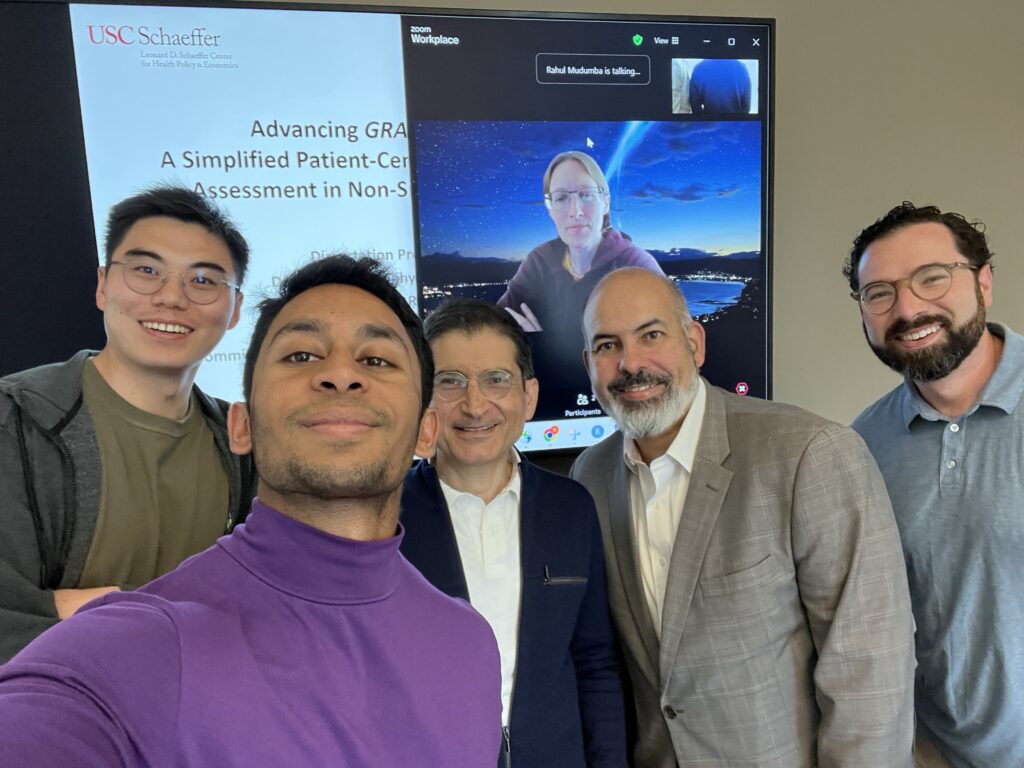
“It’s rare to see someone who holds themselves to a high standard but also is understanding and compassionate to others,” Mudumba says. “He’s one of the most successful people I know, but he doesn’t make that a point. He always carves out time for you.”
“Rahul’s talent, enthusiasm and entrepreneurial spirit shone through in his academic pursuits,” Lakdawalla says. “It was an honor to serve as a mentor to him, and we all look forward to seeing him launch his career.”
As he finishes his PhD, Mudumba is weighing opportunities across sectors, including pharmaceutical industry roles, government positions or research work in academia. He also co-founded a startup that aims to automate health economic modeling for biotech companies. The next stop remains to be seen, he says, running his own cost-benefit analysis.
His broader mission remains constant: to improve the methodology behind the decisions that shape who gets treated and how.
“We’re going to make these trade-offs anyway,” Mudumba says. “Given that we’re going to do it, we might as well do it in a rigorous, quantifiable and transparent way.”