


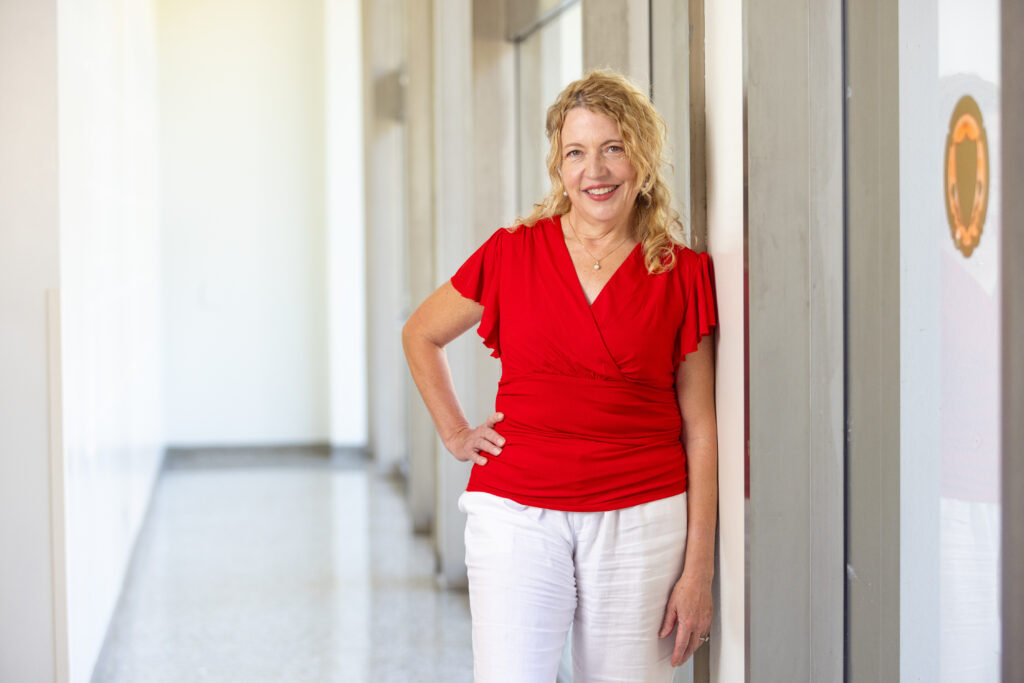
Julie Dopheide fell in love with psychiatric pharmacy as a PharmD student. Today, she cares for patients facing mental health and substance use challenges in her clinical practice while mentoring students in their Introductory and Advanced Pharmacy Practice Experience (APPE) rotations. Active in numerous professional organizations, she was selected as a member of the inaugural class of 2025 American Association of Psychiatric Pharmacists (AAPP) fellows, and served as president of AAPP’s predecessor, the College of Psychiatric and Neurologic Pharmacy. Here, she discusses her passion for mental health.
What drew you to psychiatric pharmacy?
I went to the University of Nebraska for my PharmD—one of the few pharmacy schools, along with USC that required students to do an APPE in psychiatric pharmacy. My first psychiatric rotation was at the Veterans Administration in Omaha, and I enjoyed working directly with patients. I loved psychiatry so much that I did an elective at the Nebraska Psychiatric Institute, working with children with autism, ADHD and developmental disabilities.
What does it mean to be a psychiatric pharmacist as opposed to a pharmacist or psychiatrist?
The board-certified psychiatric pharmacist combines clinical understanding of the full spectrum of mental health conditions with a pharmacist’s knowledge of evidence-based treatments.
Can you give an example of how you’ve tailored a medication plan for a patient who didn’t respond to standard treatments?
A 16-year-old male with schizophrenia experienced delusions that his neighbors were trying to kill him and his family. Hospitalized 13 times over two years, he did not respond to previous medication combinations—except for gaining significant weight. Through regular family meetings, I helped him and his family learn about clozapine, an antipsychotic often used when other drugs have failed. Without needing hospitalization, he did well on a combination of clozapine and a mood stabilizer, along with a medication for counteracting weight gain and other side effects of antipsychotics.
How do we make sure people can get the help they need?
It’s scary that some people want to disallow psychotropic medications for kids. Antidepressants can sometimes be the difference between life and death. We must keep teaching our students, residents and colleagues to value mental health and maintain evidence-based practices for using psychotropics.
What are some big changes you’ve seen in the field?
COVID really put a spotlight on the fact that mental health is just as important as physical wellbeing, and that they’re intertwined. I think people are now at least a little more open to addressing mental health issues—including substance use disorders. But now, with all the misinformation and cuts to public health programs, many of us who work in pediatric mental health are worried that people are going to go back into the shadows, because nobody wants to be deported or seen as defective or not worthy.
How would you like to see the field of psychiatric pharmacy advance?
The field needs more practitioners. So I’d love to find a way for all pharmacy programs to include the practical experience of one-on-one care for patients living with long-term mental health and substance use challenges. The Accreditation Council for Pharmacy Education does not require an APPE in psychiatry, so at USC we are infusing this experience into ambulatory and acute care and community pharmacy rotations.
We also need to confront the stigmatization that stops people from getting quality care. This would also do a lot to enhance overall patient outcomes—because people with such conditions won’t truly heal from their stroke, heart attack or diabetes if their mental health is neglected.