


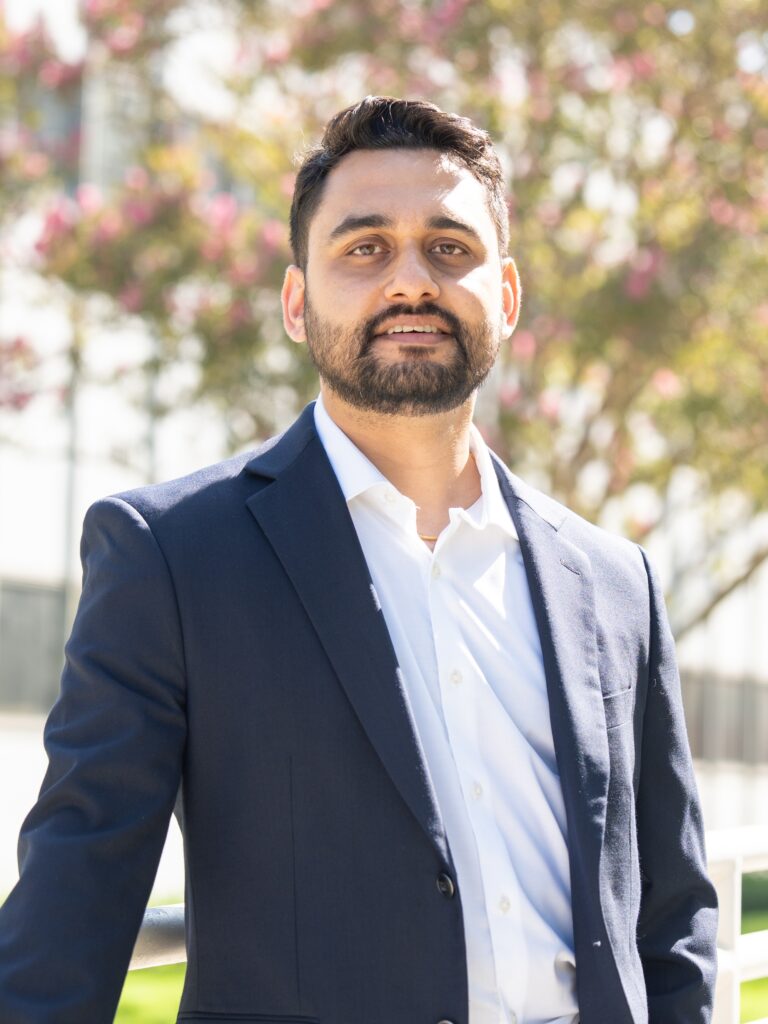
An interdisciplinary USC team led by Prashant Dogra of the USC Mann School has received a three-year, $700,000 National Science Foundation (NSF) grant to improve the reliability and versatility of digital twins for biomedical research and healthcare.
Digital twins are computer-based models designed to simulate real-world systems. In healthcare, they can help researchers predict how patients may respond to treatments, how diseases may progress and how medical devices may perform. However, many existing digital twins are developed for a single purpose and can be difficult to apply in other settings— especially when clinical data are limited.
Dogra, an assistant professor of clinical pharmacy and associate director of the Center for Quantitative Drug and Disease Modeling at USC Mann, is principal investigator for the project, “FDT-BioTech: Credible Foundations for Composable Immune System Digital Twins.” Krishna Garikipati of the USC Viterbi School of Engineering is co-principal investigator.
The team will develop mathematical and computational tools intended to make biomedical digital twins more reliable, easier to combine across systems and better able to apply knowledge from one biological setting to another. Researchers will use the human immune system as a test case for the new approach, with the aim of creating a framework that could be applied across different biomedical systems.
“Digital twins could let us test new treatments and medical devices on a computer long before they reach a patient, but only if we can trust what they predict,” Dogra says. “Our goal is to give researchers the tools to build these models from reliable, reusable building blocks and to know how much to trust a prediction, even when there isn’t much data to go on.”
Other members of the project team include Annie Wong-Beringer and Gopal Mohanty of USC Mann and Saul Priceman of the Keck School of Medicine of USC.
The award comes through FDT-BioTech, a competitive interdisciplinary program jointly sponsored by the NSF, National Institutes of Health, and Food and Drug Administration. Software and other resources created through the project will be made publicly available to encourage broader use by the scientific community.